

What is static balance and why it matters for health and performance
Team Meloq
Author
Understanding Your Foundation of Stability
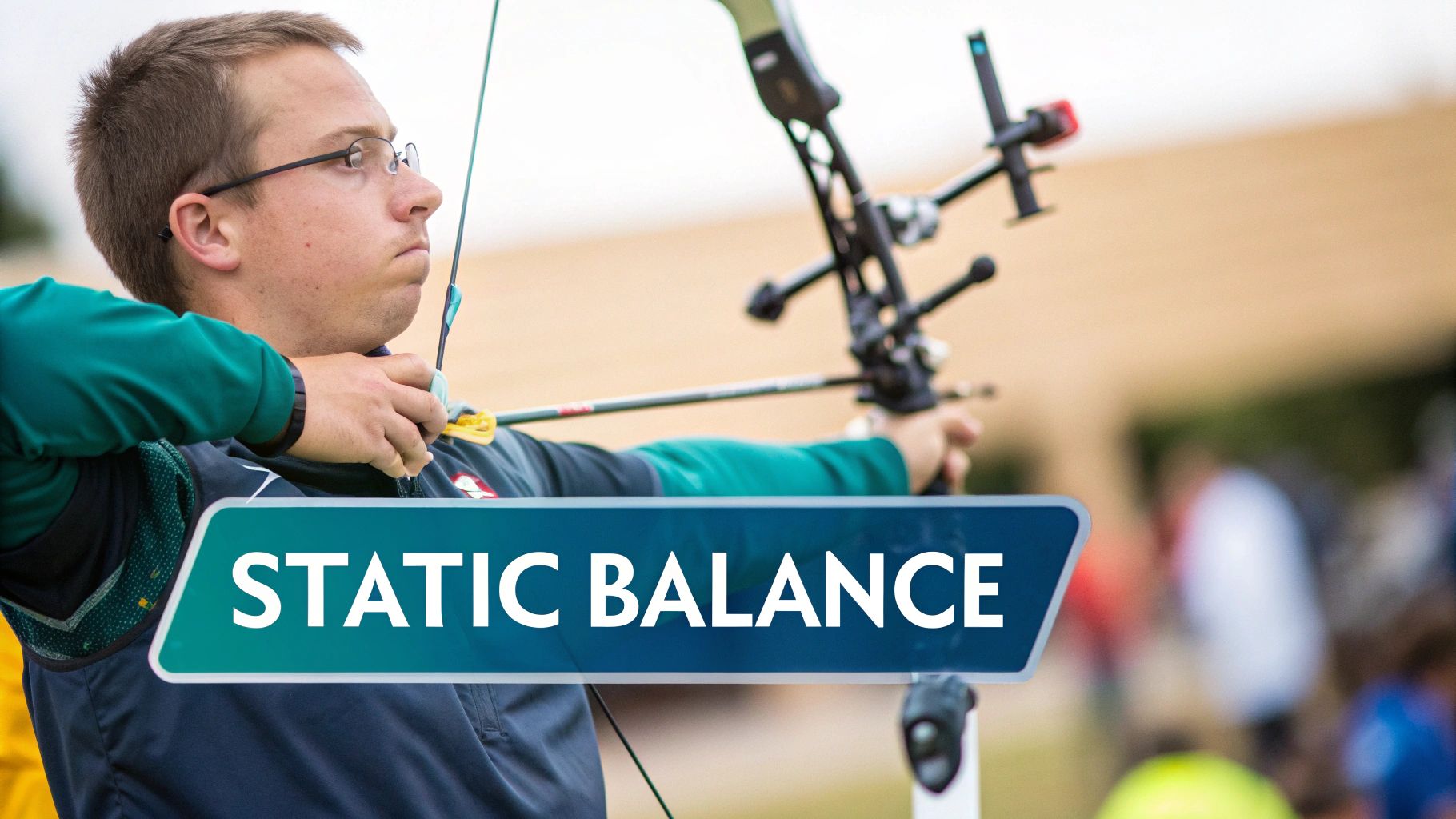
Picture a master archer just before releasing an arrow or a surgeon in the middle of a delicate procedure. Their success hinges on an almost imperceptible stillness. This ability to hold the body steady is the core of static balance, and it's the unsung hero behind countless daily activities and elite athletic feats.
But "stillness" is not a passive state. Static balance is a dynamic, continuous process. It is the neuromuscular system's ability to keep the body's centre of gravity within its base of support—the area beneath an object or person that includes every point of contact with the supporting surface (1). Even when you feel perfectly stationary, your body is making thousands of tiny, automatic adjustments to counteract the force of gravity.
This intricate dance of stability is not controlled by a single part of the body. Instead, it’s the result of a constant, high-speed conversation between the brain, sensory organs, and muscles.
The Science of Stillness
At its heart, static balance is about maintaining equilibrium against gravity. To prevent the body from tipping over, its centre of gravity must remain aligned over its foundation, or base of support. If the centre of gravity strays too far, stability is compromised.
To manage this, the brain relies on a constant stream of information from three key sensory systems:
- Vision: Your eyes provide powerful information about your position relative to your surroundings.
- Vestibular System: Located in the inner ear, this system functions like a biological gyroscope, sensing head movements and orientation with respect to gravity.
- Somatosensory System: This is a network of nerves in your skin, muscles, and joints that provides real-time feedback on pressure, stretch, and position—a sense known as proprioception.
Your central nervous system rapidly processes these signals, then directs muscles to make incredibly fine-tuned contractions and relaxations. These minute adjustments, often called postural sway, are what keep you stable and upright.
Why Your Foundation Matters
Understanding static balance is crucial because it is the platform for almost every movement. Before you can walk, run, or jump with power and efficiency, you first have to be able to stand with stability. A compromised foundation can have serious consequences, from increasing an older adult’s risk of falling (2) to reducing an athlete's power output.
Even a small deficit in a specific joint can affect the entire system. For example, learning how to measure ankle dorsiflexion is important because this specific range of motion directly impacts the base of support and overall balance. For physical therapists and strength coaches, assessing and training this foundational skill is a cornerstone of any effective injury prevention, rehabilitation, or performance programme.
The Hidden Systems Keeping You Upright
Standing perfectly still might look simple, but it's one of the most complex balancing acts your body performs. This is not a passive state of rest; it's an incredibly active process—a constant, intricate symphony conducted by the central nervous system. Think of your stability as a three-legged stool. If one leg becomes wobbly, the whole structure is at risk of toppling over.
This "stability stool" relies on three key sensory systems. They work together, feeding a continuous stream of information to your brain about your body's position in space. Your brain then makes countless, lightning-fast adjustments to your posture, ensuring your centre of gravity stays safely over your base of support.
Let’s break down each leg of this stool.
Your Visual System: The Watchtower
Vision is often our most dominant sense for balance. It acts like a watchtower, constantly scanning the horizon and giving your brain crucial information about your surroundings, how you're oriented to the objects around you, and any movement happening nearby. This is why you feel far more stable in a well-lit room than you do in the dark.
When you stand still, your eyes detect subtle sways by referencing your position against the fixed environment. If you lean forward slightly, your eyes register that the wall in front of you appears closer, signalling your brain to initiate a corrective action. However, over-reliance on vision can be a disadvantage, especially when the environment provides misleading information—like on a moving boat.
Your Vestibular System: The Internal Gyroscope
Tucked away deep inside your inner ear is the vestibular system, your body's own personal gyroscope. This organ has nothing to do with hearing; its sole job is to sense head motion, your orientation to gravity, and acceleration. It tells your brain if you're upright, leaning, or lying down, independent of visual input.
The system is made up of fluid-filled canals and chambers that detect rotational movements (like shaking your head) and linear movements (like ascending in an elevator).
When you tilt your head, for instance, the fluid inside these canals shifts. This sends an immediate signal to your brain about the change in position. This system is essential for maintaining balance when visual cues are absent or conflicting.
Your Somatosensory System: The Ground Crew
The third leg of our stability stool is the somatosensory system. Think of this as your body's ground crew. It's a vast network of sensory receptors in your skin, muscles, tendons, and joints that provides real-time feedback about your body's position and contact with the world. This is the system that lets you feel the floor under your feet and know where your arms are without looking at them.
A critical part of this is proprioception. It's thanks to specialized nerve endings that constantly report on joint angles, muscle tension, and the relative position of body parts.
- Pressure Receptors: In the soles of your feet, these receptors detect the slightest shifts in weight, informing your brain which parts of your feet are bearing the most load.
- Muscle Spindles: These receptors detect changes in muscle length and the rate of that change, allowing for incredibly fine-tuned postural corrections.
- Golgi Tendon Organs: Located where muscles connect to tendons, they monitor muscle tension to refine motor control and prevent excessive force.
Together, these three systems—visual, vestibular, and somatosensory—feed a rich, continuous stream of data to the central nervous system. Your brain integrates these signals and sends precise commands back to your muscles. The result is thousands of tiny, unconscious adjustments that create what we call static balance: a state of controlled, active stillness.
Comparing Stillness and Movement
While the terms static and dynamic balance are sometimes used interchangeably, they describe two distinct—though deeply connected—skills. Understanding the difference is crucial for professionals in rehabilitation, injury prevention, and athletic development.
The distinction comes down to one simple factor: stillness versus motion.
Static balance is your ability to hold a stationary position and control your body's natural sway. Think about standing on one leg, holding a yoga pose, or staying perfectly still before a golf swing.
Dynamic balance, on the other hand, is about maintaining stability while moving. This covers everything from walking on an uneven surface to landing a jump or changing direction on a sports field.
The Key Differences At a Glance
Although they work as a team, these two types of balance utilize different neuromuscular strategies and challenge the body in unique ways. Understanding this helps clinicians and coaches pinpoint and address specific weaknesses more effectively.
Let's break down the core differences in a simple table.
Comparing Static and Dynamic Balance
| Attribute | Static Balance | Dynamic Balance |
|---|---|---|
| Primary Goal | Maintain a fixed position | Control the body during movement |
| Base of Support | Constant and predictable | Constantly changing |
| Centre of Gravity | Kept within the base of support | Controlled as it moves in and out of the base of support |
| Real-World Example | Holding a yoga tree pose | Walking along a narrow beam |
| Training Focus | Improving postural stability | Enhancing coordination and reaction time |
As you can see, it's all about context. Both involve stability, but the conditions under which that stability is required define the skill.
How Stillness Supports Movement
Here’s a key takeaway: static balance is the foundation for dynamic balance. It is difficult to control the body effectively in motion without first being able to control it while still.
An athlete with solid static balance has a stable base from which to generate force, absorb impact, and react efficiently.
In fact, research in sports physiotherapy has shown associations between poor single-leg static balance and a higher risk of injuries like ankle sprains and ACL tears (3). A plausible explanation is that the body may lack the fundamental stability to handle dynamic loads effectively.
The brain juggles input from three key sensory systems to manage both types of balance, as you can see in the diagram below.
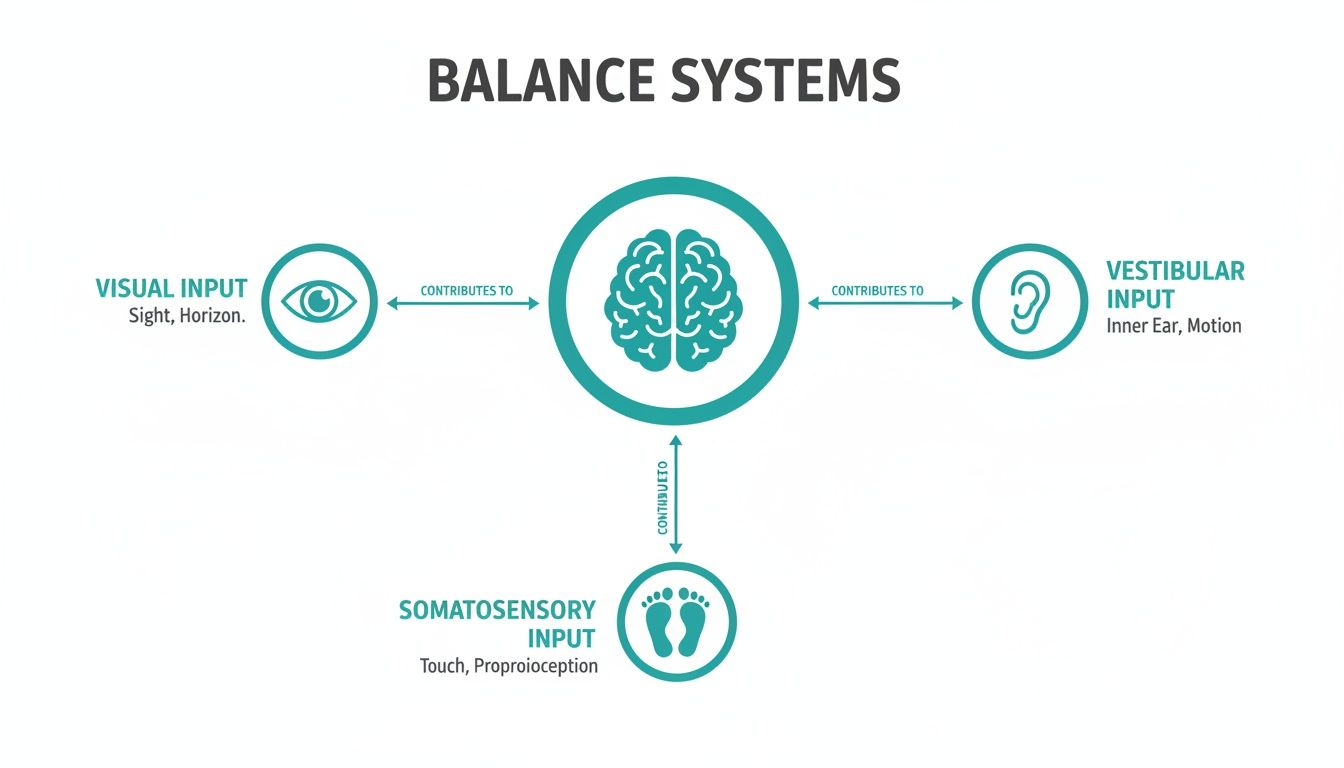
Your brain is constantly integrating information from your eyes (visual), inner ear (vestibular), and body position sensors (somatosensory) to build a complete picture of where you are in space. This constant feedback loop allows you to maintain both static and dynamic control.
Because of this deep connection, clinicians and coaches should address both. A rehabilitation programme that only uses stationary exercises might leave a patient vulnerable when they return to daily life. Likewise, a training programme that skips over foundational static control may not be as effective as it could be.
This is where objective tools become indispensable. To see how professionals get precise stability measurements, you can learn more about how force platforms in biomechanics are changing the game.
Why Static Balance Is So Much More Than Just Standing Still
Static balance isn’t just an abstract concept; it’s a foundational skill woven into nearly everything we do. It’s the silent workhorse that keeps us upright and the unwavering anchor for precise movements. Its real impact, however, is most evident when it’s compromised—both in clinical settings and on the athletic field.
When someone’s static balance is impaired, it can be a significant indicator for a physical therapist. It can point to underlying issues or predict future problems, which is why its assessment is so important.
The Clinical Importance of a Stable Base
In a clinical setting, testing static balance provides a direct window into how a patient's nervous system and body are communicating. A shaky performance can be a clue to a neurological issue or a clear sign of recovery progress.
For instance, in individuals with Parkinson's disease, increased postural sway is a hallmark symptom and a major contributor to their high risk of falls (4). For someone recovering from a stroke, regaining static balance is often a primary goal—it’s the first step toward safely standing and walking again.
It’s not just about neurological conditions. A common ankle sprain can disrupt the vital sensory feedback from the joint. If this connection isn't retrained, it can lead to chronic instability and an increased risk of re-injury.
One of the most critical takeaways is this: static balance is a powerful predictor of fall risk in older adults. Faltering stability is directly tied to a higher chance of falling, which can lead to serious injury and a loss of independence (2). For this reason, assessing and improving static balance is a cornerstone of healthy ageing programmes.
The Foundation of Athletic Excellence
For any athlete, static balance is the launchpad for power and precision. The explosive, dynamic movements that define athletic performance—sprints, jumps, and throws—are all built on a bedrock of solid static control.
Without it, energy can be wasted. It's like trying to fire a cannon from a canoe.
This is especially apparent in sports that demand pinpoint accuracy.
- Shooting Sports: An archer's or marksman’s performance hinges on their ability to minimize body sway. That near-perfect stillness is elite static balance in action.
- Golf: The golf swing is a masterclass in generating rotational power from a stable base. Any wobble during the setup or backswing can compromise the shot's effectiveness.
- Gymnastics & Martial Arts: Holding a handstand or a complex stance isn't just about strength; it's about incredible static control. This stability allows for the safe and effective execution of explosive movements.
Research has shown a link between better static balance, higher performance, and fewer non-contact injuries (3). An athlete who can confidently stand on one leg has a more resilient neuromuscular system, better prepared to handle the intense forces of their sport. This makes static balance training a non-negotiable component of any serious athletic programme, bridging the gap between raw strength and true, functional performance.
How to Measure and Assess Your Stability
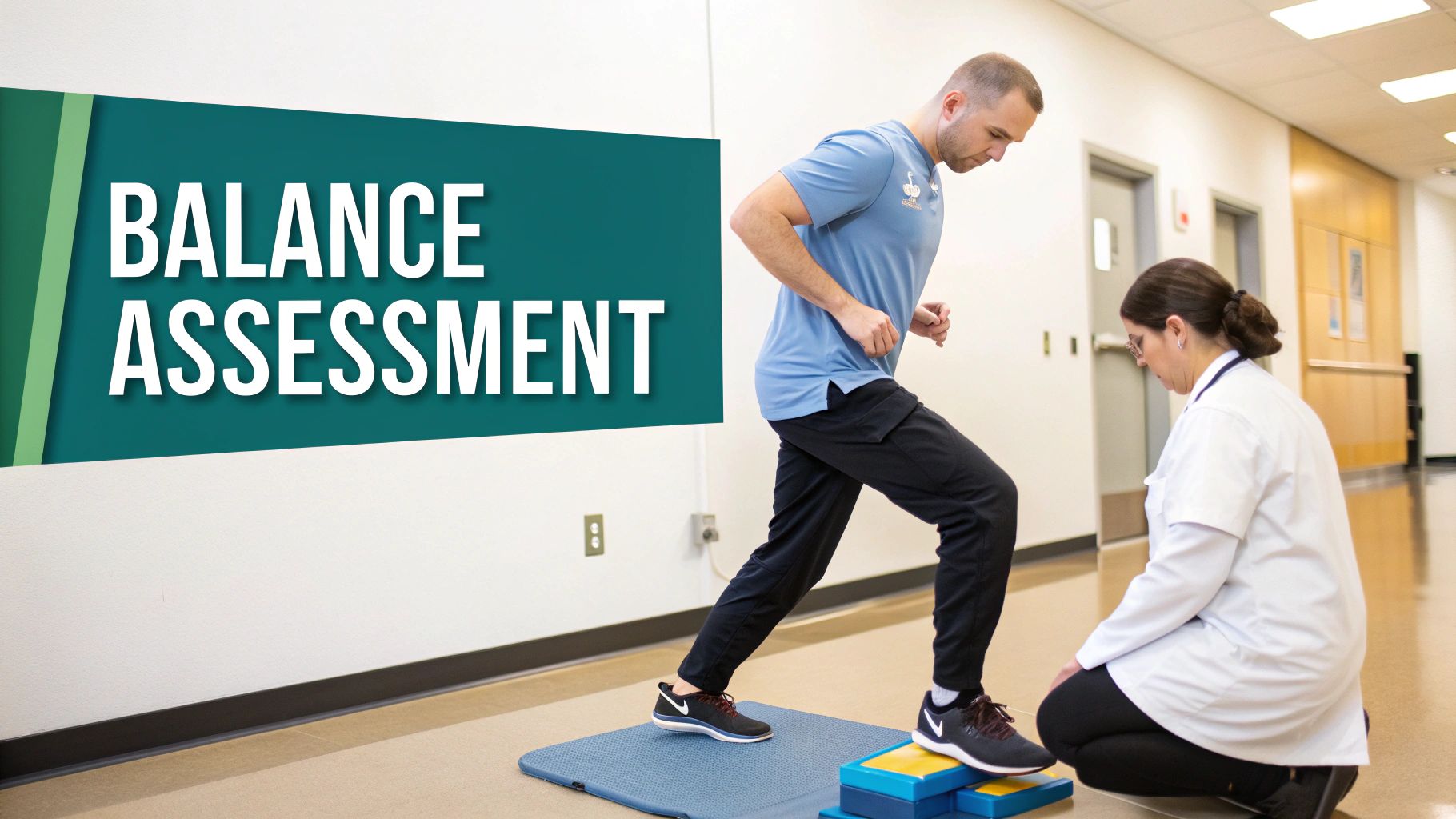
Before you can improve static balance, you need a starting point—a way to measure it. In physiotherapy and performance science, quantifying stability provides objective data to track progress, identify deficits, and make informed decisions.
Assessment methods range from highly precise laboratory tools to practical clinical tests. The right tool depends on the context. A high-performance sports lab has different needs than a community health clinic, but both aim to answer the same fundamental question: how well can this person control their postural sway?
The Gold Standard Lab Assessments
In research or elite performance settings, the gold standard for measuring static balance is the force plate. This highly sensitive equipment measures ground reaction forces, delivering incredibly detailed data on postural control.
Force plates work by tracking the movement of the Centre of Pressure (COP), which is the application point of the total ground reaction force vector. By analysing COP data, key metrics can be extracted to provide a clear picture of an individual's stability.
- COP Path Length: The total distance the COP travels during the test. A longer path indicates more postural sway and potentially less efficient balance control.
- Sway Velocity: This metric measures how fast the COP is moving. Higher velocity suggests the person is making rapid, constant adjustments to stay upright, which can be a signal of a less stable system.
- Sway Area: This calculates the total area the COP covers. A larger area can point to greater instability and poorer control over the centre of gravity.
These quantitative measures are invaluable. They allow for the detection of subtle changes in balance that the naked eye might miss, making them essential for high-level athletic monitoring and clinical research.
Practical Clinical Balance Tests
Force plates are not always practical for everyday clinical settings. Fortunately, several simple, low-tech tests provide excellent functional insights into a person's static balance. These tests are quick, require minimal equipment, and have been validated through research.
The goal with these clinical tests is to systematically challenge the sensory systems—visual, vestibular, and somatosensory—to identify weaknesses. By changing the base of support or removing visual feedback, we can pinpoint where the system may break down.
The Romberg Test
This is a foundational test used to get a quick assessment of neurological function. The protocol is straightforward:
- The individual stands with their feet together and arms crossed over their chest.
- First, they hold this position for 30 seconds with their eyes open.
- Then, they repeat it for another 30 seconds with their eyes closed.
If someone sways excessively or loses their balance with their eyes closed (a positive Romberg's sign), it suggests a potential issue with their somatosensory or vestibular systems. It indicates they may be over-relying on vision to maintain stability (5).
The Unilateral Stance Test
Also known as the single-leg stance test, this is a more challenging assessment of static balance.
- The individual stands on one leg, with the opposite knee bent so the foot isn't touching the standing leg.
- The time they can hold this position without losing balance is recorded, usually with a cutoff of 30 or 45 seconds.
This test is sensitive to age-related decline and is a strong predictor of fall risk (2). To see how it's applied in geriatrics, you can find more details about various balance assessment tests for elderly populations.
The Balance Error Scoring System (BESS)
The BESS test is a staple in sports medicine, particularly for concussion assessments (6). It is more involved, requiring three different stances performed on both a firm surface and an unstable foam pad:
- Double-leg stance (feet together)
- Single-leg stance (on the non-dominant foot)
- Tandem stance (heel-to-toe)
Each stance is held for 20 seconds with eyes closed. The assessor counts the number of "errors"—such as lifting hands off hips, opening the eyes, or stumbling. A higher error score indicates poorer balance. This test systematically challenges all three sensory systems, providing a comprehensive, functional snapshot of an individual's static balance.
Actionable Protocols for Improving Balance
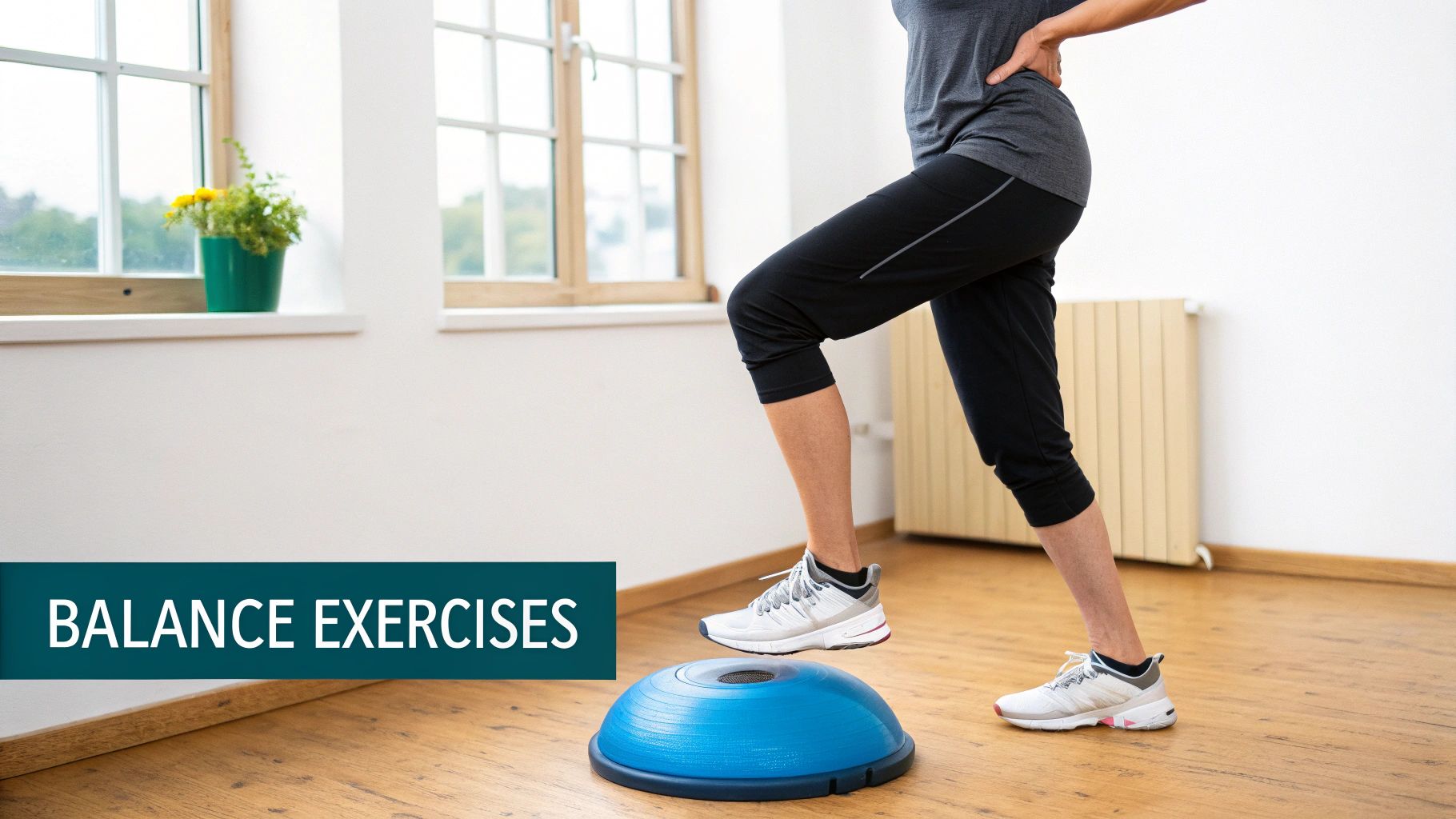
Knowing how to assess static balance is only half the battle. The real work begins with effective training. The good news is that balance systems are highly trainable.
Whether working with a post-surgical patient or an elite athlete, consistent and progressive challenges can lead to significant improvements in stability.
The core principle is progressive overload. This means that to improve, you must consistently push your body just beyond its current comfort zone. For balance training, this involves systematically making the stability task harder. This forces the neuromuscular system to adapt, becoming faster and more efficient at integrating sensory information to control posture.
It is always recommended to have a qualified physiotherapist or coach design a programme, as they can tailor it to individual needs and ensure safety.
Building Your Foundation
Every solid balance programme starts with mastering the basics on a firm, stable surface. These foundational exercises fine-tune the connection between the brain and the muscles controlling posture, without adding too many confusing variables.
A simple, effective progression looks like this:
- Feet-Together Stance: Start by standing with feet touching for 30-60 seconds. This narrows your base of support and provides a good initial challenge.
- Tandem Stance: Place one foot directly in front of the other, heel-to-toe. Hold this for 30 seconds on each side. This challenges stability from front to back.
- Single-Leg Stance: This is a cornerstone of static balance work. Stand on one leg, lifting the other foot off the ground. Aim to hold it for 30-45 seconds without wobbling or touching down.
Once these feel comfortable and controlled, you are ready to introduce more complex challenges that target specific sensory systems.
Advancing Your Training with Sensory Challenges
To build robust stability, you need to challenge all three pillars of the balance system: your visual, vestibular, and somatosensory inputs. This can be done by strategically tweaking the environment or adding new tasks to the foundational exercises.
Challenge Your Vision and Vestibular System
The simplest way to force your brain to rely less on what it sees is to remove vision from the equation. Close your eyes.
Performing a single-leg stance with your eyes closed is a completely different ball game. You'll immediately feel your somatosensory and vestibular systems working harder to keep you upright. It's an incredibly powerful way to sharpen those internal senses.
Challenge Your Somatosensory System
Next, introduce an unstable surface. A foam pad, balance disc, or BOSU ball are all excellent tools for this. These surfaces provide less reliable feedback to the receptors in your feet, forcing your nervous system to make faster, more precise adjustments. Begin with a two-footed stance on foam and gradually progress to single-leg variations.
Introduce Dual-Tasking
In the real world, you are rarely just focusing on balancing. You're walking while talking or carrying groceries. Dual-task training mimics these real-life demands by adding a cognitive challenge to a balance exercise.
For example, try standing on one leg while counting backwards from 100 by sevens, or gently tossing a ball against a wall. This trains the brain to maintain postural control automatically, even when attention is divided. For more advanced ideas, check out these balancing exercises for athletes.
Enhancing Balance with Biofeedback and Equipment
Modern tools can accelerate motor learning by providing real-time feedback. Using a portable force plate, for example, allows someone to see their postural sway on a screen as it happens. This immediate visual feedback helps them develop a better internal sense of their centre of gravity and learn strategies to control it more effectively.
Additionally, equipment designed to improve core strength, such as Pilates reformers, can be a fantastic supplement to any balance programme. A strong, stable core is fundamental to maintaining good static balance.
Your Questions Answered
Let's clear up a few common questions about static balance.
Does Static Balance Naturally Decline with Age?
Yes, our ability to hold steady can gradually decrease as we get older (2). It is a normal part of the ageing process, as our vestibular system, nerve conduction speed, and muscle mass all change over time.
However, this decline is not inevitable. Targeted balance training has proven incredibly effective at improving stability and, most importantly, significantly reducing the risk of falls in older adults (2, 7).
Can I Have Strong Muscles but Still Have Poor Balance?
Absolutely. This is a common misconception. While a good foundation of strength is necessary for stability, it is only one piece of a much larger puzzle.
Balance is a skill, not just raw power. It hinges on the rapid communication between your sensory systems—what you see, feel, and sense from your inner ear—and your brain's ability to coordinate a response. You can have strong leg muscles, but if your nervous system is slow to process feedback and activate the right muscles at the right time, your static balance will be compromised.
How Quickly Can I Improve My Static Balance?
With consistent and focused training, most people start to feel more stable in just a few weeks of regular practice (e.g., three to four times a week).
Measurable neurological adaptations—the brain and nerves becoming more efficient—can occur within 4-6 weeks (8). This is where more significant and lasting improvements in postural control are often observed.
References
- Winter DA. Human balance and posture control during standing and walking. Gait & Posture. 1995;3(4):193-214.
- Rubenstein LZ. Falls in older people: epidemiology, risk factors and strategies for prevention. Age and Ageing. 2006;35(Suppl 2):ii37-ii41.
- Hrysomallis C. Relationship between balance ability, training and sports injury risk. Sports Medicine. 2007;37(6):547-56.
- Kim S, Kim M, Lee K, Jeon B. Postural instability in patients with Parkinson's disease: a quantitative analysis. Journal of Clinical Neurology. 2011;7(2):80-7.
- Lanska DJ, Goetz CG. Romberg's sign: development, adoption, and adaptation in the 19th century. Neurology. 2000;55(8):1201-6.
- Guskiewicz KM. Assessment of postural stability following sport-related concussion. Current Sports Medicine Reports. 2003;2(1):24-30.
- Sherrington C, Tiedemann A, Fairhall N, Close JCT, Lord SR. Exercise to prevent falls in older adults: an updated meta-analysis and best practice recommendations. New South Wales Public Health Bulletin. 2011;22(3-4):78-83.
- Adkin AL, Frank JS, Jog MS. Fear of falling and postural control in Parkinson's disease. Movement Disorders. 2003;18(5):496-502.
At Meloq, we believe that objective data is the key to better outcomes. Our ecosystem of portable, accurate tools—from the EasyAngle goniometer and EasyForce dynamometer to the EasyBase force plate—is designed to help professionals like you move beyond guesswork. We empower you to quantify progress with real numbers. Visit us at https://www.meloqdevices.com and see how our devices can help you measure what truly matters.

Featured Product
EasyBase Force Plates
Portable dual force plate system for jump testing, balance & rehab. No subscription fees.
Learn More